Why Material Science Determines Realism and Durability
In the engineering of realistic dolls, material selection is one of the most critical factors influencing durability, tactile realism, hygiene performance, and long-term structural stability.
For over a decade, Thermoplastic Elastomer (TPE) has been widely used across the industry due to its soft texture and cost-efficient manufacturing process. However, standard TPE formulations can present several well-known limitations including oil migration, odor buildup, and mechanical fatigue after prolonged stress.
To address these issues, manufacturers have introduced enhanced polymer formulations such as ROS MAX, designed to improve structural integrity and surface stability while maintaining the softness that users expect from elastomer-based materials.
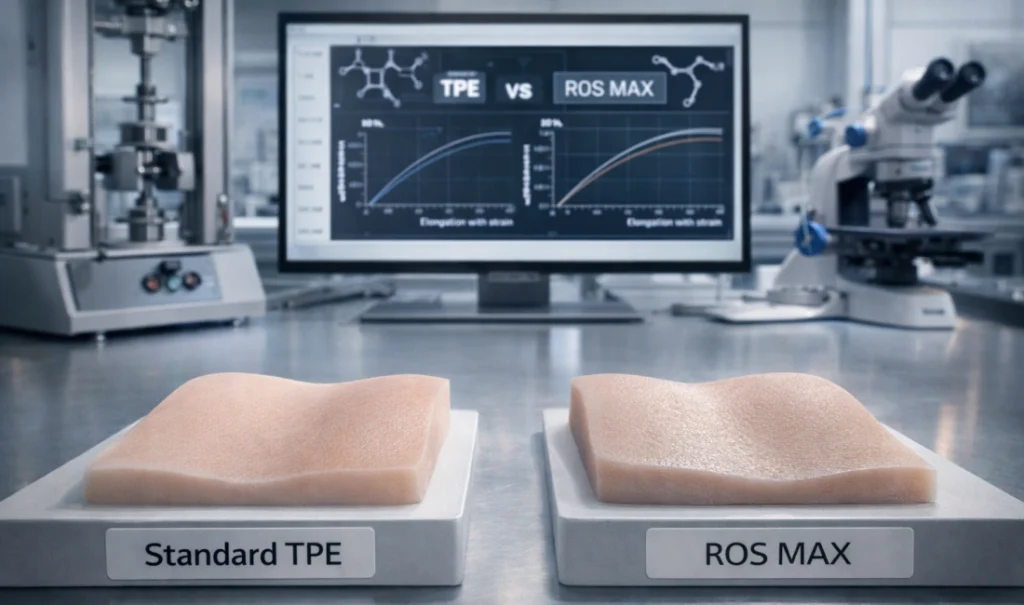
This article provides a technical comparison between ROS MAX and standard TPE materials from a material engineering perspective.
Understanding Standard TPE
Thermoplastic Elastomer is a class of polymers combining characteristics of rubber and plastic. It can be molded through heat processing while retaining elastic flexibility after cooling.
Standard TPE used in doll manufacturing typically consists of:
- polymer base matrix
- plasticizers to maintain softness
- stabilizers and pigments
These components allow manufacturers to create skin-like softness at relatively low production cost.
However, standard TPE formulations also rely on plasticizers to maintain elasticity. Over time these plasticizers may migrate toward the material surface, which can lead to oiliness, stickiness, and gradual loss of structural stability.
For this reason, many manufacturers have begun developing improved elastomer blends to enhance durability and surface stability.
What Is ROS MAX Material?
ROS MAX is an optimized elastomer formulation designed to overcome some of the structural weaknesses commonly found in traditional TPE materials.
Although specific formulas vary by manufacturer, ROS MAX typically involves:
- enhanced polymer cross-link density
- improved plasticizer binding stability
- reinforced molecular structure
- These modifications help increase tear resistance and reduce oil migration while maintaining elasticity.
The objective of ROS MAX is not simply to create a softer material, but to produce a more structurally stable elastomer suitable for long-term use.
Structural Durability
Durability is one of the most important factors for owners of realistic dolls. Because dolls contain articulated internal skeletons, the surrounding material must withstand repeated mechanical stress during repositioning.
Standard TPE can be vulnerable to tearing in high-stress zones such as:
- shoulder joints
- hip joints
- underarm areas
- ROS MAX materials generally demonstrate improved tear propagation resistance. The reinforced polymer network distributes mechanical stress more evenly across the material, reducing the likelihood of localized damage.
- While no elastomer is completely tear-proof, ROS MAX formulations are typically engineered to provide higher mechanical resilience under regular use conditions.
Elastic Recovery and Shape Memory
Elastic recovery refers to the ability of a material to return to its original shape after compression or deformation.
Standard TPE materials often provide excellent initial softness but may gradually develop compression marks after repeated pressure.
ROS MAX aims to improve this behavior by enhancing the internal polymer structure, allowing the material to recover more efficiently after compression.
This results in improved shape memory, which helps maintain natural body contours over time.
Surface Stability and Oil Migration
One of the most frequently discussed challenges with TPE materials is oil migration.
Plasticizers used in conventional TPE can slowly migrate to the surface of the material, producing a slightly oily texture. This process may also increase odor levels over time.
ROS MAX formulations are designed to reduce this phenomenon through stronger plasticizer binding within the polymer structure.
As a result, the material surface tends to remain more stable and less prone to excessive oil buildup.
Odor Control
Odor perception is another important factor influencing user experience.
Standard TPE materials can sometimes release volatile compounds during early use stages, especially if the formulation contains lower-grade additives.
Enhanced elastomer systems like ROS MAX typically incorporate improved stabilizers and refined production processes to minimize volatile compound release.
This results in a lower initial odor profile and more stable long-term performance.
Hygiene and Maintenance
Both TPE and ROS MAX require proper maintenance to ensure long-term performance.
Regular cleaning and surface powdering help maintain smooth texture and prevent stickiness.
However, materials with reduced oil migration such as ROS MAX generally require slightly less maintenance over time, as the surface remains more stable and less prone to residue buildup.
Long-Term Aging Performance
All elastomer materials gradually age due to environmental factors such as:
- temperature fluctuations
- UV exposure
- mechanical stress
- oxidation
Standard TPE may experience gradual softening or discoloration after extended use.
ROS MAX materials are typically formulated with additional stabilizers to slow this aging process and preserve mechanical properties longer.
Performance Comparison
| Property | Standard TPE | ROS MAX |
|---|---|---|
| Elastic recovery | Moderate | Improved |
| Tear resistance | Moderate | Higher |
| Oil migration | Noticeable over time | Reduced |
| Odor control | Moderate | Improved |
| Surface stability | Medium | Higher |
| Long-term durability | Moderate | Improved |
ROS MAX Material in Real-World Doll Models
To better illustrate how ROS MAX material performs in practical applications, several modern realistic doll models incorporate this enhanced elastomer formulation. These models are designed to combine improved structural durability with lifelike tactile realism.
Below are three examples of dolls that utilize ROS MAX or advanced material systems.
153cm Curvy Miku – ROS MAX Elastomer Model
The 153cm Curvy Miku model demonstrates how ROS MAX material can provide enhanced softness while maintaining structural stability. The balanced body proportions and improved elastic recovery help preserve natural contours during repositioning.
Key characteristics include:
- ROS MAX elastomer skin formulation
- improved elasticity and compression recovery
- realistic tactile softness
- optimized body weight distribution
Product page:
https://xlifedoll.com/products/irontechdoll-ros-sex-doll-153cm-curvy-miku
158cm Busty Yui – High Elastic ROS MAX Structure
The 158cm Busty Yui model highlights the benefits of ROS MAX material in larger body structures where durability and tear resistance are particularly important.
The enhanced elastomer formulation helps distribute stress around joints and curves, reducing the risk of localized material fatigue over time.
Key characteristics:
- ROS MAX elastomer construction
- enhanced tear resistance
- improved elasticity for body contour stability
- detailed sculpting for realistic appearance
Product page:
https://xlifedoll.com/products/irontechdoll-ros-sex-doll-158cm-busty-yui
167cm Tan Penny – Advanced Material Alternative
The 167cm Tan Penny model uses a premium silicone material system, offering an alternative material approach compared to elastomer-based dolls.
While ROS MAX focuses on improving TPE-type elastomers, silicone-based dolls provide benefits such as reduced surface porosity and improved long-term chemical stability.
Key characteristics:
- high-grade silicone skin
- durable material surface
- natural skin tone finish
- long-term structural stability
Product page:
https://xlifedoll.com/products/irontechdoll-silicone-sex-doll-167cm-tan-penny
Material Selection and User Preference
Selecting between ROS MAX elastomer and silicone materials ultimately depends on individual preferences and usage expectations.
Buyers who prioritize:
- high elasticity
- soft tactile realism
- flexible posing
often prefer advanced elastomer materials such as ROS MAX.
Those seeking:
- maximum durability
- reduced maintenance
- long-term surface stability
may consider silicone alternatives.
Understanding these material differences allows users to choose a realistic doll model that best aligns with their expectations and long-term ownership goals.
Conclusion
Material engineering continues to play a central role in the evolution of realistic doll manufacturing.
While standard TPE remains widely used due to its affordability and softness, advanced elastomer formulations such as ROS MAX demonstrate improvements in durability, elastic recovery, and long-term surface stability.
For buyers seeking enhanced durability and reduced maintenance requirements, ROS MAX represents a meaningful evolution in elastomer material technology.