
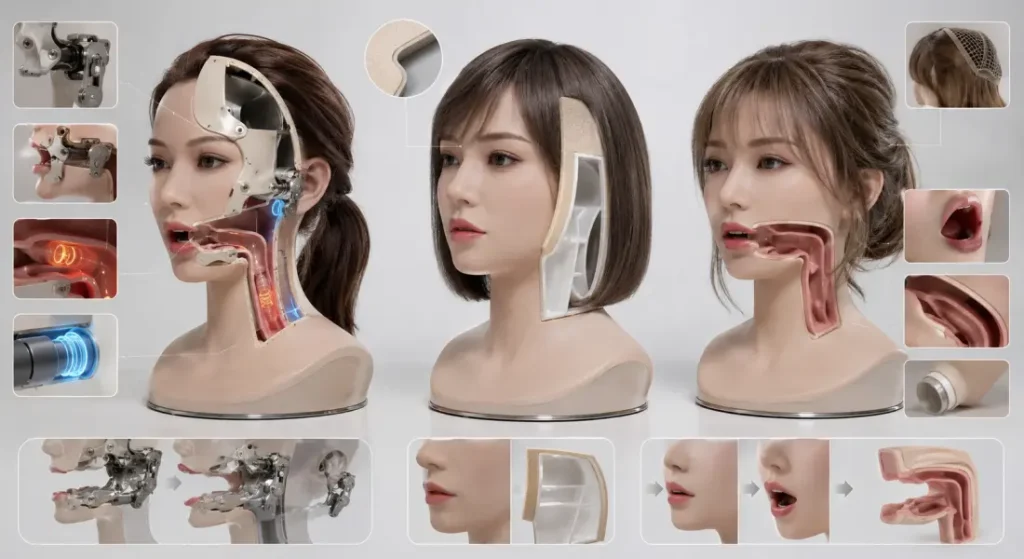
Modern sex doll heads are becoming more complex than a simple choice between TPE and silicone.
Behind the face, several engineering layers may be involved:
- outer material;
- mouth architecture;
- jaw mechanism;
- oral-channel design;
- hair and cosmetic construction;
- heating or suction modules;
- cleaning and drying requirements.
A manufacturer demonstration reviewed for this article compares three configurations:
- ROS head
- hard silicone head
- TPE head
The key technical lesson is not that one type is universally better.
It is this:
Material, mouth architecture, jaw design, and oral-system technology are separate product specifications.
Quick Answer
A modern sex doll head can combine different materials with different mouth systems.
In the demonstrated product line, the ROS head uses soft silicone and combines a movable jaw with an internal oral system. The shown hard silicone head uses firmer silicone but has a fixed mouth and no oral channel. The demonstrated TPE head uses TPE and includes oral functionality, but its standard oral channel is shallower than the ROS version; deeper TPE versions are also available.
That means:
Silicone does not automatically mean ROS, and an oral-capable mouth does not automatically mean movable-jaw technology.
On This Page
- How Modern Sex Doll Heads Are Structured
- Material Layer: TPE vs. Silicone
- Mouth Architecture: Fixed, Openable, or Articulated
- How Movable-Jaw Technology Works
- How Oral Channels Differ
- What Makes an ROS System Different?
- Hair and Cosmetic Construction
- Oral Heating and Auto-Suction
- Cleaning and Drying as Part of System Design
- Lubricant Compatibility
- What Current Evidence Does Not Confirm
- Why Head Technology Matters
- Frequently Asked Questions
How Modern Sex Doll Heads Are Structured
A useful way to understand head technology is to separate it into layers.
Layer 1: Material
Examples include:
- TPE;
- softer silicone;
- firmer silicone.
Layer 2: Mouth Architecture
The mouth may be:
- fixed;
- openable;
- connected to an internal oral channel.
Layer 3: Jaw Mechanism
A mouth may rely on:
- flexible material;
- no mechanical jaw;
- an articulated lower-jaw mechanism.
Layer 4: Internal Oral System
If present, the oral system can differ in:
- channel depth;
- internal geometry;
- cleaning method;
- drying method;
- lubricant compatibility.
Layer 5: Optional Functional Modules
Some head systems may add:
- oral heating;
- auto-suction;
- other powered components.
This layered model is more accurate than treating the head as a single feature.
Material Layer: TPE vs. Silicone
Material affects feel and construction, but it does not determine every function.
In the manufacturer demonstration:
- the ROS head uses soft silicone;
- the hard silicone head uses firmer silicone;
- the TPE head uses thermoplastic elastomer.
The relative wording matters.
The demonstration does not provide numerical hardness data, so it supports:
ROS = softer silicone relative to the hard silicone version
but not:
a specific Shore hardness value.
Likewise, the fact that both ROS and hard silicone heads use silicone does not mean they share the same mouth design.
That leads to a basic engineering principle:
Material class and functional architecture should be evaluated independently.
Mouth Architecture: Fixed, Openable, or Articulated
This is one of the most commonly confused areas in sex doll head terminology.
Fixed Mouth
A fixed-mouth head has no meaningful opening mechanism or internal oral system in the demonstrated configuration.
The hard silicone head shown in the video belongs to this category.
Openable or Oral-Capable Mouth
A head can contain a mouth opening and internal oral channel without using a mechanical lower-jaw system.
Some TPE oral heads fit this category.
Articulated / Movable Jaw
A movable jaw uses a mechanical structure that changes the lower jaw position.
The demonstrated ROS head uses this design.
Therefore:
Openable mouth ≠ movable jaw.
This distinction is more important than the outer material itself when comparing oral-system technology.
How Movable-Jaw Technology Works
The manufacturer video establishes that the demonstrated ROS head includes a movable jaw.
What can be stated safely is:
- the mouth can open;
- the lower-jaw position is mechanically articulated;
- the jaw is part of the ROS functional architecture.
What the video does not establish is:
- exact jaw angle;
- hinge geometry;
- internal fastener design;
- maximum load;
- expected service life.
Those parameters require factory engineering documentation.
So the technically correct description is:
Movable-jaw technology adds a mechanical articulation layer to the head, rather than relying only on flexible material around the mouth.
This is the key difference from an oral mouth that simply opens through material flexibility.
How Oral Channels Differ
The video compares the ROS and TPE configurations by oral-channel depth.
ROS
The ROS system functions as the deeper reference configuration in the demonstration.
Standard TPE
The standard TPE version shown has a shallower oral channel.
Deeper TPE Versions
The same manufacturer demonstration confirms that deeper TPE variants also exist.
This means oral-channel architecture should be treated as its own specification.
The current evidence supports:
ROS shown = deeper reference
Standard TPE shown = shallower
Some TPE variants = deeper channel available
It does not support invented measurements.
Without model-specific manufacturer data, exact values should remain unpublished.
What Makes an ROS System Different?
In the demonstrated product line, ROS is described as:
Real Oral Sex Head
That wording comes from the manufacturer demonstration and should not automatically be treated as an industry-wide acronym definition.
The demonstrated ROS system combines:
- soft silicone;
- movable jaw;
- internal oral function;
- implanted-hair support;
- implanted eyebrow support;
- implanted eyelash support.
It also supports optional:
- oral heating;
- auto-suction.
The important technical point is that ROS is not just a material label.
It represents a multi-layer head system.
A useful engineering model is:
Soft silicone shell → articulated jaw → oral channel → optional powered functions
Hair and Cosmetic Construction
Head technology also includes how cosmetic elements are integrated.
The manufacturer demonstration confirms that both the ROS and hard silicone heads support:
- implanted hair;
- implanted eyebrows;
- implanted eyelashes.
For the TPE head, the demonstration instead refers to a wig-based configuration.
That should not be interpreted as proof that every TPE head must use a wig or cannot support implantation.
The evidence only establishes:
Implantation support is confirmed for the demonstrated ROS and hard silicone heads, but not confirmed for the demonstrated TPE configuration.
This is a good example of why technical comparison tables should not force every column to contain symmetrical data.
Oral Heating and Auto-Suction
Some modern oral systems incorporate powered functions.
In the manufacturer demonstration, the ROS head can optionally be configured with:
- oral heating
- oral auto-suction
The word optional matters.
These features should not be described as standard ROS equipment.
The current video does not provide validated values for:
- heating temperature;
- warm-up time;
- heating element design;
- suction pressure;
- suction modes;
- motor specification.
Those details remain outside the verified evidence set.
Cleaning and Drying Are Part of the Engineering
Once a head contains an internal oral channel, cleaning and drying become part of the system design.
That is not merely a hygiene issue.
It is also a maintenance-engineering issue.
The Aura technical-confirmation document requires separate factory-verified procedures for vaginal, anal, and ROS cleaning/drying, together with approved maintenance products and lubricants.
This is important because it shows that:
An ROS channel should be treated as a distinct internal system with its own maintenance requirements.
For documented WM DOLL TPE products, the maintenance manual instructs users to:
- remove the head and wash it separately;
- clean orifices with mild antibacterial soap and water;
- dry gently;
- avoid full submersion because water entering internal structures can cause corrosion and internal mold growth.
So the maintenance chain is:
Oral system → cleaning → complete drying → storage
A fixed-mouth head without an internal oral channel does not require this same internal process.
Lubricant Compatibility Is a System Specification
Lubricant should not be selected from the head label alone.
The relevant variables are:
- outer material;
- internal oral material;
- adhesives;
- seals;
- powered components;
- manufacturer compatibility guidance.
For the WM DOLL TPE products covered by the current manual, the manufacturer specifies water-based lubricant only and warns that silicone-based or petroleum-based oils can damage that documented TPE material.
The Aura technical-confirmation document takes the same evidence-first approach by requiring approved lubricant specifications for ROS and other internal systems rather than relying on assumptions.
So the broader technical rule is:
Lubricant compatibility belongs to the complete oral-system specification, not just the material name.
What Current Evidence Does Not Confirm
A technical explainer should identify uncertainty as clearly as confirmed features.
The current demonstration and supporting documents do not establish universal values for:
- exact ROS oral depth;
- exact TPE oral depth;
- jaw range of motion;
- ROS hinge construction;
- internal ROS material composition;
- oral-heating temperature;
- auto-suction pressure;
- motor specification;
- expected ROS service life;
- replacement procedure for every internal component;
- universal oral capability of hard silicone heads;
- universal implantation capability of TPE heads.
The Aura technical-confirmation document explicitly states that approximate technical values should not be supplied unless factory verified.
That is the correct standard for discussing emerging sex doll head technology.
Why Head Technology Matters
The evolution of sex doll heads is moving away from simple:
TPE vs. silicone
comparisons.
A more technically accurate framework is:
Material
↓
Mouth Architecture
↓
Jaw Mechanism
↓
Oral Channel
↓
Powered Functions
↓
Maintenance System
This explains why two silicone heads can function very differently.
One may be:
firmer silicone + fixed mouth
while another may be:
soft silicone + movable jaw + oral channel + heating + suction
The material may overlap, but the engineering does not.
That distinction is likely to become increasingly important as more manufacturers add mechanical and electronic systems to otherwise conventional doll heads.
A Better Way to Classify Sex Doll Heads
Instead of relying on one broad product label, a future technical specification should identify at least these fields:
| Specification | Example |
|---|---|
| Head material | TPE / soft silicone / firmer silicone |
| Mouth type | Fixed / openable |
| Jaw system | None / movable jaw |
| Oral channel | None / standard / deeper version |
| Hair system | Wig / implanted |
| Eyebrow system | Applied / implanted / model-specific |
| Eyelash system | Applied / implanted / model-specific |
| Heating | None / optional |
| Suction | None / optional |
| Lubricant requirement | Manufacturer verified |
| Cleaning method | Manufacturer verified |
| Drying method | Manufacturer verified |
This type of specification is far more useful than simply saying:
“Silicone head”
or:
“TPE head.”
Conclusion
Modern sex doll head technology is best understood as a combination of materials and systems.
The manufacturer demonstration reviewed here shows three distinct approaches:
- ROS: soft silicone combined with a movable jaw, oral channel, implantation support, and optional heating or auto-suction.
- Hard silicone: firmer silicone with implantation support and a fixed non-oral mouth in the demonstrated version.
- TPE: TPE construction with oral-capable configurations, including standard and deeper channel variants.
The broader technical lesson is:
Do not classify a sex doll head by material alone.
A complete evaluation should separately identify:
material, mouth architecture, jaw mechanism, oral-channel design, powered functions, and maintenance requirements.
That framework produces a more accurate picture of how modern head systems are actually engineered.
Related Market Resources
This article explains the technology behind modern sex doll head systems. For current commercial configurations and regional availability, see:
- XLifeDoll U.S. — ROS, silicone and TPE head options
- XLifeDoll Germany — Sexpuppen-Köpfe und Oralsysteme für Deutschland und die EU
Frequently Asked Questions
What is sex doll head technology?
Sex doll head technology includes more than the outer material. It can involve mouth construction, jaw mechanics, oral-channel design, hair implantation, heating, suction, and maintenance requirements.
What is a movable-jaw sex doll head?
A movable-jaw head uses a mechanical lower-jaw structure that changes jaw position. This is different from an oral mouth that opens only through material flexibility.
What is an ROS head?
In the manufacturer line demonstrated in the supplied video, ROS is described as a Real Oral Sex Head. The shown system combines soft silicone, a movable jaw, an internal oral channel, implantation support, and optional heating or auto-suction.
Is every silicone head an ROS head?
No. Silicone describes material, while ROS describes a particular functional head configuration in the demonstrated product line.
Can a TPE head have an oral channel?
Yes. The demonstrated TPE head includes an oral channel. The standard version shown is shallower than the ROS configuration, while deeper TPE versions are also available.
Is an open mouth the same as a movable jaw?
No. A head may contain an oral opening without a mechanical jaw. A movable jaw requires an articulated lower-jaw system.
Do oral head systems require internal cleaning?
Yes. Internal oral channels require cleaning and complete drying. Exact procedures should follow factory-approved instructions for the specific system.
What lubricant is used in TPE oral systems?
For the WM DOLL TPE products covered by the current manufacturer manual, water-based lubricant is specified. Other head systems should follow their own verified compatibility requirements.